


It should have felt like progress. Not rapid or transformative progress, true – we don’t really go in for that sort of thing in Scotland – but progress, nonetheless.
Following the historic opening of the Thistle, the UK’s first safe consumption room, in Glasgow earlier this year, it was reported late in August that two potential sites had been identified by Edinburgh City Council for a similar facility in the capital, that would allow users of intravenous drugs to inject in a safe environment under the supervision and support of medical professionals.
As if further proof was needed, the urgent necessity of these facilities was soon demonstrated by the release of Scotland’s annual drug death figures, which – while showing a welcome 13% fall in fatalities across 2024 – reconfirmed Scotland’s status as the drugs death capital of Europe for the seventh year in a row.
With the prospect of further safe consumption rooms, one could be forgiven for believing that progress, however ponderous and incremental, was being made. Unfortunately, any such optimism was quickly curdled by the spectacle of history repeating itself, with every bad-faith argument against the Thistle unsheathed once more, and the debate around harm reduction in Scotland again dominated by it’s most and discredited vociferous opponents. This will only happen if we let it.
Once news of potential new facilities in the capital broke, the Scottish Tories’ shadow drugs minister Annie Wells generously volunteered to speak on behalf of the people of Edinburgh, claiming they would be “horrified” by the thought of a consumption room in their city and condemning the Scottish Government’s support for “state-sponsored drug taking”.
Wells’ remarks were soon echoed by Scottish Labour health spokesperson Jackie Baillie, who harrumphed in the Scotsman: “The whole point of such [safe consumption] rooms should be to go out of business by directing users to the rehabilitation they need so that they never come back… And yet, rather than focusing on rehab, the SNP’s policy is to decriminalise drugs.”
Finally, with a predictability you could set a Swiss watch to, the wrath of Annemarie Ward was unleashed. “This is not just a policy debate. It is a moral one,” Ward thundered in ThinkScotland. “Scotland has chosen to fund safer ways to stay in addiction rather than real exits from it.”
Ward, the CEO of the charity FAVOR (Faces & Voices of Recovery UK), will be familiar to anyone who has taken even a cursory interest in Scottish drugs policy over the past few years, as seemingly no article on the subject in the nation’s press is complete without her reliably fulminating comment.
While Ward has grudgingly allowed that harm reduction measures such as methadone may have their place, her main preoccupation is making sure that place is as small and inaccessible as possible. Wherever there is proof that harm reduction, destigmatisation, decriminalisation or legalisation yield positive results, Ward will materialise to assure us that any such evidence has been fabricated, exaggerated, misinterpreted or deprived of some dark context.
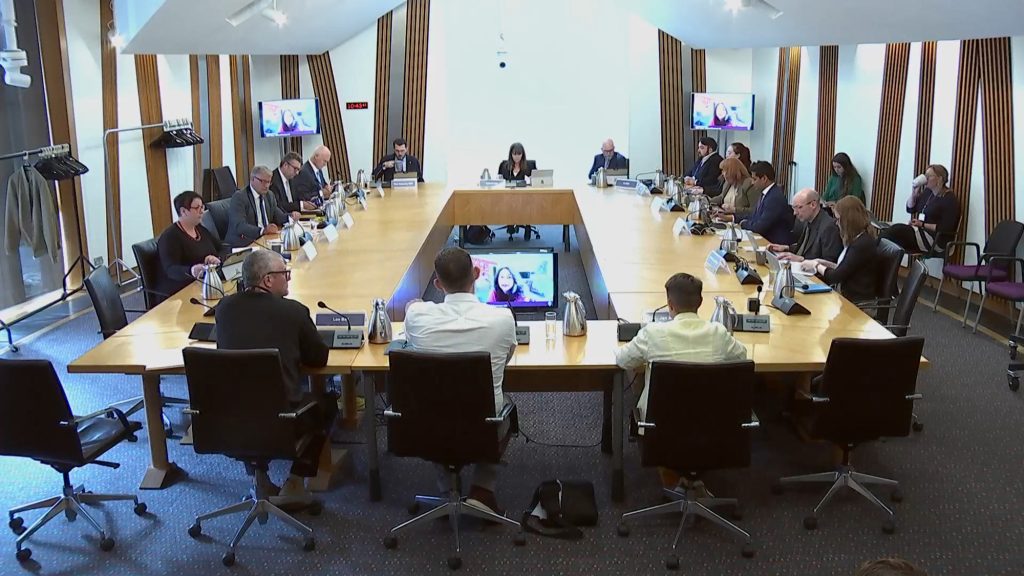
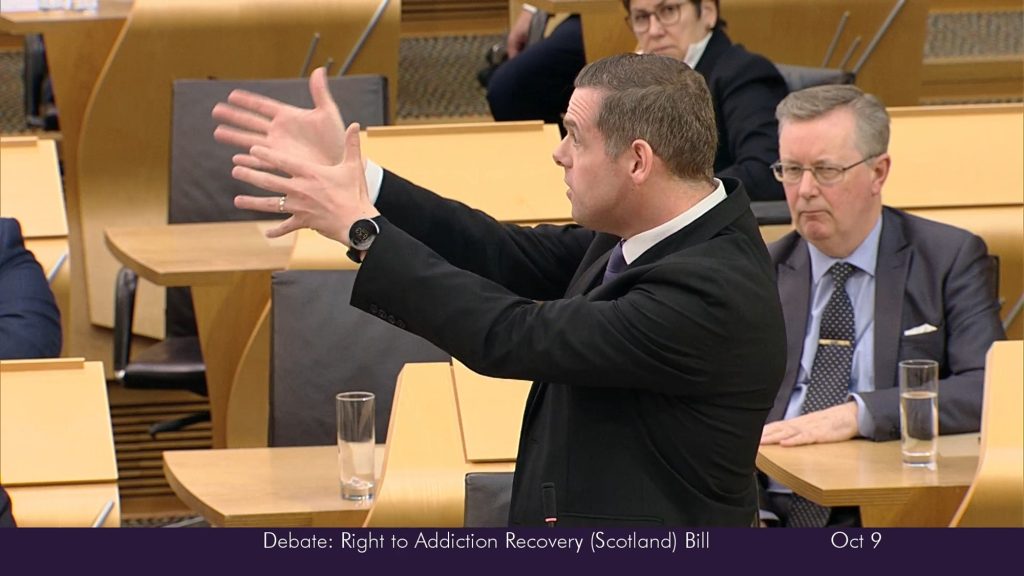
The extent to which Scotland’s opposition parties have come to mirror Ward’s evangelical fervour was most clearly demonstrated last week, when Douglas Ross’ Right to Addiction Recovery (Scotland) Bill was narrowly rejected in Holyrood at Stage 1.
Speaking in parliament last Thursday, Ross did not even attempt to deny that the bill was riddled with flaws, but repeatedly called on the Scottish Government to back it anyway, arguing that any problems can be fixed later. (It may be illuminating to compare this easy-going approach to other contentious pieces of legislation about which the Tories were noticeably less amenable, but that’s by the by.)
The problems with the bill, which set out to enshrine a legal right to treatment for those suffering from drug and alcohol addictions, had already been laid out in a response from the Scottish Drug Forum: the fact that almost all current residential rehabilitation is provided by either the third or private sector, for example, would mean that “these providers of services would potentially be able to increase the cost to the NHS and other commissioners knowing that their services were commissioned without question regarding funding”, draining NHS resources in the process.
Even if its proposals were feasible, the SDF argued that the bill placed a “disproportionate emphasis on abstinence-based treatments”. It is hard not to be believed that this is precisely what it was intended to do, as well as acting as a useful cudgel against the whole approach of harm reduction.
No Green and SNP MSP speaking in opposition to the bill dared suggest that the diversion of resources away from harm reduction was the intent of those who designed it; I lack their politeness, so I will. That intent was not difficult to discern, given the disdain dripping from every dystopian reference to the Thistle made by Labour and the Tories.
Explaining the Scottish Government’s opposition, Drug and Alcohol Policy Minister Maree Todd thanklessly enumerated the reasons the bill was unworkable, before articulating precisely why it was undesirable in terms guaranteed to infuriate opponents of harm reduction: not every road to recovery is the same, and “recovery is not just about abstinence”. To them, this is the truth that must not be spoken.
Highlighting how bereft this discourse around drugs in Scotland have become, the only acknowledgement of the sorry state of present drugs law came from Patrick Harvie, who ended his contribution to the debate by calling for reform of the “wildly out of date” Misuse of Drugs Act.
That Harvie’s suggestion was a lonely one is unsurprising – those who backed the Right to Recovery Bill and oppose harm reduction initiatives overwhelmingly emerge from the prohibitionist tradition. Speaking to the Daily Mail ahead of the opening of the Thistle, Annemarie Ward complained that “it started off 30 years ago and we were assured by the stalwarts of the harm reduction ideology that this was not in any way, shape or form a Trojan horse for legalisation”. If only it actually were – if so, Scotland might have actually made some progress over those intervening decades.
“The War on Drugs has consistently failed for a century, doing untold harm in the process, to the poorest peoples and nations most of all.”
As those who take an international view will know, Portugal’s move towards decriminalisation in 2001 saw a significant drop in drug-related deaths, HIV infections and the number of people in prison for drug offences; it did not, however, lead to vast swathes of the populace suddenly embracing the daily routine of Hunter S. Thompson, but why let the facts get in the way of a good paranoid fantasy?
Scotland’s most vocal prohibitionists are wont to refer to harm reduction as a vast and nefarious industry, concerned only with its own enrichment and self-preservation – they should try looking in a mirror. Those fighting to deny Scotland the safe consumption rooms and drug law reform it desperately needs do so because their own approach to addiction is wedded to the War on Drugs that has consistently failed for a century, doing untold harm in the process, to the poorest peoples and nations most of all. Despite this, that war has always been politically advantageous for those who would get on board with it, so it is no surprise that some would rather not see it sink.
Scotland needs and deserves a better conversation about drugs, and we have precious few people willing or capable of making it happen; the late campaigner Peter Krykant was one of them.
Following yet another swiftly-denied call by the Scottish Government in 2023 for drugs to be decriminalised for personal use or for powers to be devolved to Holyrood to bring this about, Krykant wrote in the National that while “most people who use drugs do so without any negative impacts on their lives”, a criminal record “can be more damaging than drug use”. Moreover, any harm reduction strategies are undercut while drugs remain criminalised, as Krykant himself discovered when he audaciously launched a mobile consumption room in 2020, the first facility of its kind anywhere in the UK.

Krykant’s willingness to articulate these simple yet always controversial truths threatened the narrative of those who oppose harm reduction and remain invested in the War on Drugs. Perhaps it should not have been surprising, then, that in the immediate aftermath of his passing, some took cowardly advantage of the fact he was no longer around, all while throwing dirt on his memory.
Chief among them was the writer, commentator and Scotland’s answer to Vanilla Ice Darren McGarvey, every conservative’s favourite left-wing firebrand, who waited ten whole days after Krykant’s death before revealing the “dark truth” behind the activist, writing in UnHerd that “his ideology shifted from moderate to unhinged” and that he had aligned “with voices who, if they had their way, would see town centres and city streets lined with vending machines dispensing heroin and Valium”.
Krykant’s death was very sad, ran the implication of his hatchet-bearing obituarists, but was essentially the fault of the very philosophy he espoused, and could have been avoided if only he had rejected harm reduction for the salvation of abstinence. If this is the level of respect such people show for the dead, I am somewhat sceptical of their commitment to the welfare of those still living.
While Krykant’s recognition that drug use often has systemic roots might make things awkward for anyone who’s built a successful brand piously lecturing on the need for “personal responsibility”, other critics of Scotland’s current approach to harm reduction have at least acknowledged the context of poverty and inequality from which addiction often emerges.
For whatever reason however, few are willing to pursue this understanding to its unavoidable conclusion: capitalism has never existed without also producing the kind of deprivation that inspires those trapped within it to seek escape by whatever means they can, even if that escape leads to oblivion.
Among all the bold new solutions proposed to addiction in our country, guaranteed housing, income, and freedom from want and criminalisation never seem to be among them. Those who condemn harm reduction as a stopgap rarely grapple with the impossibility of tackling addiction without anything approaching socialism.
Out of respect for Krykant’s legacy and all he achieved, we should not merely mourn his passing, but work to ensure the silence left by his absence is not filled by the nauseating mixture of religious moralism and rank opportunism touted by cultic prohibitionists and professional self-publicists. If we can manage that, Scotland’s relationship with drugs may – finally – progress into something better.

Contributor
Sean Bell is a writer and journalist based in Edinburgh. His work has appeared in The National, The Herald, Source and Jacobin.
Tags