No contentment in victory, no surrender to injustice – the Supreme Court and trans rights, one month on
by Sean Bell


In the wake of last month’s unanimous decision by the UK Supreme Court, which ruled that the terms ‘woman’ and ‘sex’ refer under equalities law to “a biological woman and biological sex”, I found myself curious if the aftermath might answer a question that had been nagging at me for some time.
To those who marched us to this juncture – sometimes styled as the ‘gender-critical’ lobby, so darkly animated by their opposition the rights, liberation and reality of trans people that it has become the cracked prism through which they view the whole world – what exactly does victory look like?
Judging by their jubilation, one could be forgiven for thinking this was it. As an ass-covering addendum, Judge Lord Hodge cautioned against “reading this judgment as a triumph of one or more groups in our society at the expense of another – it is not”. This was somewhat undercut by the popping of prosecco corks.
After years of demanding to speak to the manager, the gender-critical lobby had finally been granted the legal imprimatur to have those they judge unworthy ejected from womanhood itself. A former children’s author anointed as this cohort’s patron saint materialised on social media, radiating the most evil ever seen aboard a yacht not named the Oneida and regrettably demonstrating that the dangers of the Bermuda Triangle are much exaggerated. “I love it when a plan comes together,” gloated JK Rowling.
“That’s all we wanted,” ran the headline to Sonia Sodha’s final column in the Observer, but the gender-critical lobby’s track record suggests otherwise – this is far from the first time they have declared victory, and none have left them satisfied.
For a great while, it was opposition to Gender Recognition Reform and the principle of self-ID that propelled them; thanks to the UK Government – the intervention of which revealed some within the independence movement as being perfectly relaxed with London overruling Scottish democracy, provided the outcome suited them – both were stalled indefinitely. The cause du jour then became squashing gender-affirming care for young people; with the aid of an amenable judge and the extremely dubious Cass Review – the intended purpose of which the erstwhile Tory government at Westminster barely bothered to conceal – they once again got what they wanted. Each time, they moved on to a new target.
Within days of the Supreme Court decision, the Scotsman’s Susan Dalgety was eagerly anticipating beginning “the work… to strip out identity ideology from public bodies”. The movement which for years claimed to be victims of a reborn McCarthyism now hungers to start disinfecting our society of the beliefs which so repulse them. You could call this irony, though other words do spring to mind.
“Law-making is power-making, assumption of power, and to that extent an immediate manifestation of violence,” Walter Benjamin argued. The Supreme Court’s decision has not made law as such, but it has altered the way in which the law will be applied, declaring where and with whom power resides – with those who view the rights of trans women as weaker, fewer, less legitimate, and more in need of qualification than those of cisgender women – whilst simultaneously intensifying that power’s ability to widen the gulf between the rights of trans people and everyone else. In his Critique of Violence, Benjamin distinguished between law-making violence (rechtsetzend Gewalt) and law-preserving violence (rechtserhaltende Gewalt). In the Supreme Court’s ruling, we have seen the former; it remains to be seen what manifestation the latter will take as that ruling is put into force.
Still, it is worth putting this latest victory for the gender-critical lobby in context. Who, exactly, did they persuade in order to secure it? The Supreme Court, obviously – that’s no small potatoes; the overwhelming bulk of the nation’s establishment media, or at least the people that run it; multiple UK governments, along with a great many politicians either crankish or craven. But beyond that… who?
Consider the fact that those opposed to trans rights in the UK have never managed to swing a single election. New electoral vehicles in Scotland which made transphobia a central part of their platform have either imploded with comical speed or languish in the single figures. In Westminster, Labour came to power on a manifesto that promised a trans-inclusive ban on conversion therapy, and to “remove indignities from trans people who deserve recognition and acceptance”, which in no universe translates to putting Wes fucking Streeting in charge of their healthcare.
During the last SNP leadership race, both of the gender-critical set’s favoured champions, Ash Regan and Kate Forbes, failed to ascend to the head of the party, though the latter did eventually manage to secure the office of deputy first minister through a backroom deal precisely zero people voted upon. Meanwhile, Joanna Cherry’s loss of her seat in last year’s general election did not exactly provoke rioting in the streets, nor did the party finally getting shot of Fergus Ewing.
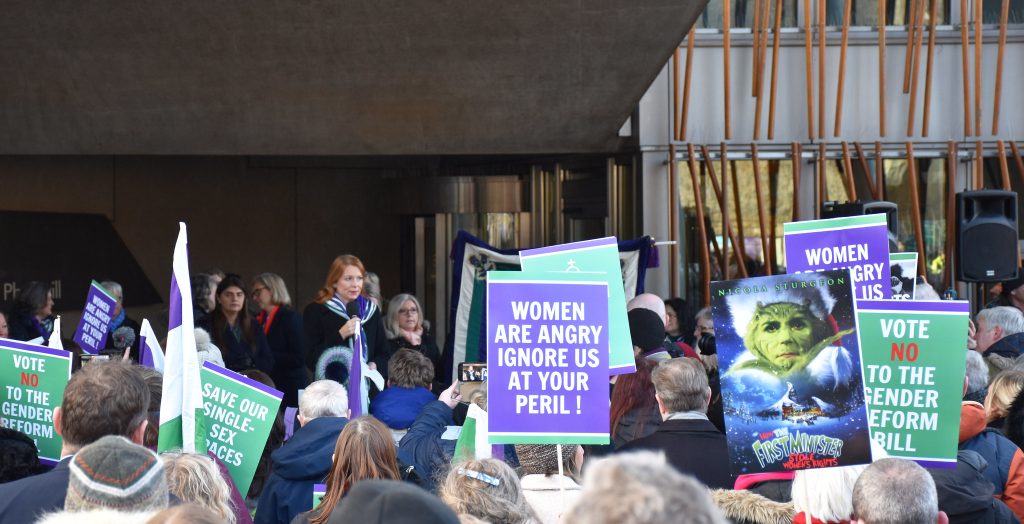
And yet, Scottish and UK opponents of trans rights have achieved virtually everything they set out to do, other than gain a mandate to do any of it. This is a strange exception, given how often this lobby claims to speak on behalf of the majority – a majority so silent and supine, it can apparently only summon a few hundred of its number every time they attempt to put on a show of ‘strength’ outside Holyrood.
* * *
So how were these victories achieved? For years, anti-trans voices have attributed those advances made by trans rights over the 21st century to ‘institutional capture’, though it is rarely explained how said capture took place. Such conspiracist mutterings also never examine precisely how virtually every national newspaper in Scotland and the UK decided almost simultaneously to offer regular and prominent space to the ‘gender-critical’ perspective. British journalism is a precarious and embattled industry, yet the safest jobs within it seem to belong to a small, superannuated coterie who regurgitate variations on the same bollocks each week, finding new and ever-more tortuous ways to link all evils back to the nefarious ‘gender ideology’.
Precisely what radicalised so many of Britain’s commentariat into such swivel-eyed paranoia may vary case-by-case, but much can be attributed to the preceding decade or so, during which trans rights achieved heretofore unprecedented prominence – ‘peak woke’, as the most tiresome people on the planet are wont to describe it – and offered those who opposed trans rights, trans liberation and trans people a blood-curdling glimpse into another possible world.
In this world, students might have power comparable to the institutions which supposedly exist for their benefit, workers might be in a position to dictate terms to bosses and executives, journalists might not have to bow in deference to editors and pundits with the cushiest of berths, and a marginalised and oppressed minority might make demands of those in power and not have them immediately ignored.
This nightmarish dystopia never really came to pass – it never even came close. But the thought alone was enough to terrify them. Clearly, something had to be done.
In this revanchist campaign, aid came from fellow travellers perhaps less openly motivated by transphobia, but nonetheless angered that they had to think about the issue of trans rights at all; who bemoan the deleterious effect of ‘culture wars’ and ‘identity politics’ on our discourse, and whose plaintive, fervent hope is that the whole inconvenient business just goes away. If they believe the Supreme Court’s judgement will bring that about, I anticipate they will be disappointed.
Unlike those benighted souls, the true believers of the anti-trans cause who rejoiced at the Supreme Court’s ruling do not, as the past month has proved, want it to go away. For them, there is no contentment in victory, because for them, victory has not yet been achieved.
First – in case you were wondering if this could get any more pathetic – they want an apology. Following the Supreme Court decision, the Herald’s Mark Smith offered his own grovelling mea culpa for ever having briefly believed that trans people might deserve some say over their own identities and personhood, and sternly instructed those politicians who thought likewise to bend the knee to transphobia and beg forgiveness. He was far from the only one demanding such supplication.
Some demand not just an apology, but a scalp. A lobby which has spent recent years inveighing against cancel culture in all its forms, which considers no injustice greater than facing consequences for one’s views, nonetheless immediately called for the sacking of Green MSP Maggie Chapman after she condemned the Supreme Court’s ruling as “bigotry, prejudice and hatred”, a statement which prompted apoplexy from the Faculty of Advocates for its implication that judges might be anything less than transcendent beings of divine logic. Despite Chapman surviving a subsequent attempt to oust her from Holyrood’s equalities committee, she is unlikely to be the last to be targeted.
They demand apologies from Nicola Sturgeon, from John Swinney and Patrick Harvie, Mhairi Black and Ross Greer; from the co-worker who signs off emails with their pronouns; from the celebrity who once told a joke that made a punchline of their rancid bigotry; from their friends and kids who inexplicably don’t call any more…
Noticeably however, there have been few such demands of trans people themselves, because to the gender-critical mindset, trans people are not to be recognised, because they are not really people. They are not really real.
And if they can persuade enough of their peers, their government and the legal system to believe likewise, if they pretend just hard enough, maybe, when they open their eyes, trans people will have finally disappeared, like a bad dream upon waking.
This is their goal. It always has been.
Of course, most prominent British opponents of trans rights will tell you that they have no problem whatsoever with trans people. They will take great offence if their views are compared to the exterminatory policies of the Trump administration, even if they struggle to specify any actual variance. They will insist they want trans people to live full, safe and happy lives… provided they don’t have to share spaces, services or protections with them, or acknowledge their identities, or have those lives presented to young people as being in any way normal or acceptable.
What a gender-critical victory looks like is a world where trans people are invisible – either because it is no longer necessary to recognise their existence, or because they no longer exist at all.
* * *
The law is – or should be – what we make it. The anti-trans lobby understand this – it is why, having failed achieve their goals democratically, they have increasingly turned to the law as a means to power and control.
Through its remit to examine those cases of the greatest constitutional bearing, the UK Supreme Court has long since revealed itself as an institution that will, by design, prop up the edifice of the British state and the status quo which flows from it – the idea that such a court would ever sign off on the potential dissolution of that state was a presumption of supreme naivete on the part of the SNP under Sturgeon. Last month, the Supreme Court demonstrated its function once again; a hostility to trans people and their rights is the policy of the UK Government, and through this ruling will be the guiding principle in the formulation and application of the law.
Shon Faye correctly argued “there can be no trans liberation under capitalism”. It is hard to see any concrete progress towards that liberation being made within the British state either. Yet this conclusion leads only to another dead end, so littered has the Scottish independence movement become with those whose disdain for trans people far outstrips any notional commitment to independence. For that cohort, national liberation can be happily sacrificed if it means the quashing of trans liberation – maybe because they have become aware, even if they won’t admit it, how one might have led to the other.
“The UK Supreme Court has long since revealed itself as an institution that will, by design, prop up the edifice of the British state and the status quo which flows from it.”
Following last month’s ruling, the Communist Party of Britain – an organisation whose views on sex and gender are so rooted in rigorous Marxist analysis that they managed to win the endorsement of Britain’s best-known billionaire – put out a feeble statement welcoming the “materialist outcome” of the Supreme Court’s decision. It may be edifying to compare and contrast with a resolution passed by the national board of the Communist Party of the United States of America in 2022:
“As Communists, we consider the fight against special oppression and for full equality as fundamental to all working-class and people’s struggles. We base our program and actions on the reality that all are hurt when one is hurt, and that overcoming transphobia – just like racism and other bigotries – raises up all peoples. This understanding enables us to present a united and effective fightback.
“Winning the long-term goal of socialism requires the unity of all workers and oppressed peoples – and that includes trans people. Our party will never be silent in the face of attacks on the trans community, no matter what forces or interests initiate them.”
I can think of no sadder indictment of the contemporary British Left than the fact that America has better tankies than we do. But a worthy declaration, nonetheless.
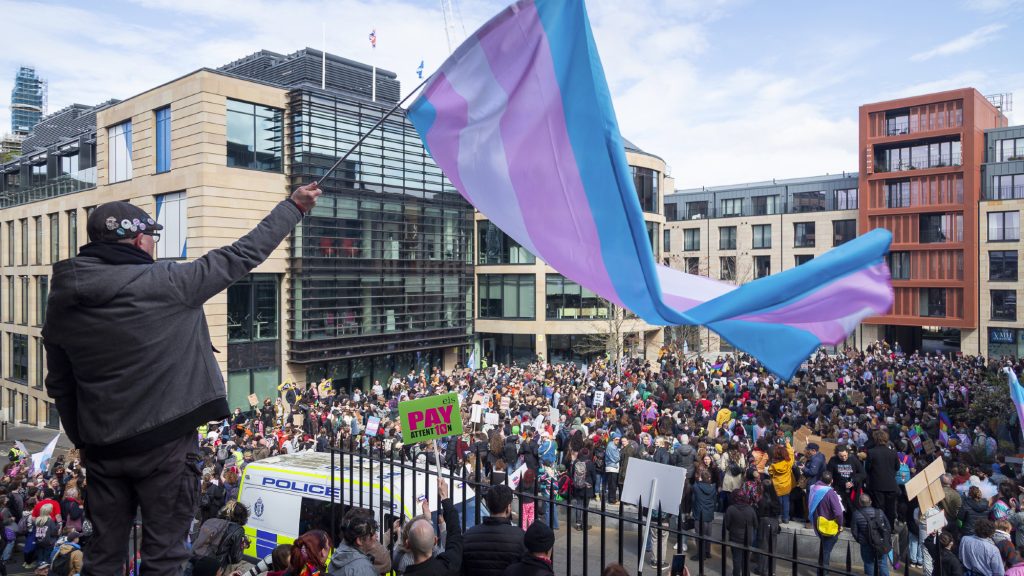
For those forces and interests set against the UK’s trans community, in the month since the Supreme Court’s ‘clarification’ of the law, it has come as an unwelcome shock to discover there are many who refuse to respect the law if it is not worthy of respect. To their further bafflement and outrage, the trans community did not immediately and meekly accept defeat, but instead turned out at protests across the UK, along with the tens of thousands who stand with them. They should get used to the sight.
I began this by asking what victory for those who oppose trans rights would look like. It may ultimately be irrelevant, because that victory would depend on people – friends and strangers, allies and comrades – abandoning each other in the face of hate.
And that is why they will never see it.

Contributor
Sean Bell is a writer and journalist based in Edinburgh. His work has appeared in The National, The Herald, Source and Jacobin.
Tags