


In an article published on 7 May, The National declared that “Only independence can rescue Scotland from the far right”. This reiterates one of our nation’s most long-standing political myths – namely, that independence can act as a one-size-fits-all solution to our myriad of problems, from record levels of poverty and economic inequality to crumbling infrastructure and climate change. This mentality has been a useful means of deflection for the SNP over its nearly twenty years in power at Holyrood; its own failings are swept under the rug with the mantra “indy first, ask questions later”.
At this stage, though, with Reform UK now in with a serious prospect of being the second-largest party in the Scottish Parliament after next year’s elections, this mentality poses a serious danger. We are kidding ourselves if we think independence will cause Reform – or the political forces that empower them – to just disappear overnight. This brings us to the difficult position the Scottish left now finds itself in. Just how do we respond to the rapid rise of the far-right through Reform UK?
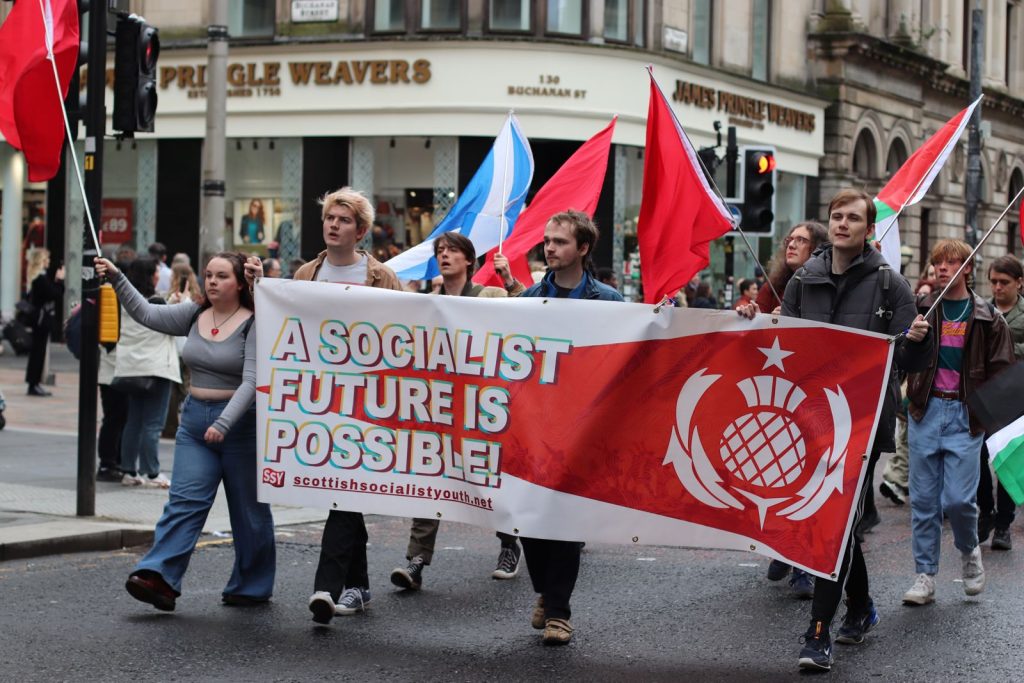
Despite intermittent bursts of activity, the Scottish left is maybe more divided and anaemic now than it has been at any point in its history. We are not ready to meet the urgency of the moment, and there is more or less no agreement on how we should rise to this challenge. We in the Scottish Socialist Youth have been working steadily but tirelessly towards building a broad-based movement to advocate for socialism and independence, and to counter the far-right, but we are under no illusion about the daunting scale of the task we and the wider left now face.
In a Heckle article published last month, the author spoke of “no line of least resistance” in relation to the left and the Scottish Parliament elections due next year. This sentiment should be applied not just to next year’s Holyrood campaign, but to how we approach the rise of the far-right in Scotland over the next few years – we must not pursue the line of least resistance. There is no easy path here; Farage and the politics he represents cannot be wished away with mild social-democratic reforms.
We should not just be arguing against the far-right, but articulating a convincing and positive alternative. Make no mistake, independence will undoubtedly provide the clean slate we need to chart a different course, and is necessary if we want radical change – but unless it comes with a bold socialist programme that materially changes people’s lives, the far-right will find a way back in an independent Scotland, as they have elsewhere.
The threat of Reform and the failure of the establishment parties
The threat posed by Reform UK and Farage’s brand of far-right politics cannot be overstated – and while we should be cautious about making overly simplistic comparisons between here and the United States, we should take Farage heaping praise on Donald Trump’s terrifying authoritarian regime seriously. We should also listen to him when he mimics Trumpian rhetoric, on everything from race and the climate crisis to immigration. Perhaps the most concerning element of all this is the inroads Reform have made into traditionally working-class and left-behind areas, of course across the north of England but also here in Scotland.
Let’s be clear – Reform is a party by billionaires, for billionaires, as the support of Elon Musk and the mass-migration of Tory donors to Farage’s new outfit should clearly tell us. In Scotland, half of their candidates in last year’s general election didn’t even live in the constituencies they ran in. When push came to shove, they showed their true colours by voting down an (admittedly modest) worker’s rights package put forward by Labour earlier this year.
But this has not stopped them from gaining significant ground in working-class areas. In the North East council by-election in Glasgow in March, Reform UK polled a healthy 24% of first-preference votes – just four points behind Labour – and nearly all recent polling suggests they will emerge as the second-largest party at Holyrood next year, behind the SNP. This would give the far-right a platform of unprecedented scale in Scotland, and would set the stage for further gains later down the line. This threat is real, and pressing – but all of our major political parties have been found seriously wanting in their response (or lack thereof).
First, we need to start with a blunt assessment of where we are. Despite our pretensions of being more left-wing than England, our governments rarely have been in practice, and over the last two decades both the SNP and Labour have facilitated a long period of managed decline in Scotland, worsened by the actions of Conservative governments down in London. We have seen poverty increasing, wages stagnating, and the basic cost of living skyrocketing. All of our major parties have thus far failed to respond to this crisis with anything more than reformist sticking plasters.
The Labour Party have been outflanked by Reform on both scrapping the two-child benefit cap and the nationalisation of key industries, like steel. Labour’s decision to support the renationalisation of the Scunthorpe steelworks alongside their refusal to provide a fair deal and transition for the refinery workers of Grangemouth show that they are preoccupied with chasing an increasingly right-wing voting bloc in England, rather than supporting the working class in Scotland.
Before the last election, Anas Sarwar promised us clear as day that there would be “no austerity under Labour”, but here we are just under a year later, with savage cuts having been made to disability benefits and the winter fuel payment, and the Labour Party having actively supported the continuation of the two-child benefit cap, which provably keeps thousands of children in poverty. This is without even getting into the party’s inhuman position on Palestine and trans rights.
The SNP, meanwhile, wear radical clothes when it suits them, but don’t back it up with concrete action – repeatedly failing to meet their own housing targets and address Scotland’s homelessness crisis, leaving thousands of patients stuck on NHS waiting lists, and missing its own interim child poverty reduction target for 2023-24. There is some merit to the claim that the SNP’s hands are tied by budget constraints imposed from London, but their failure to, for example, replace council tax with a land or property-based wealth tax, shows that they are still firmly a party of capital.
“Over the last two decades both the SNP and Labour have facilitated a long period of managed decline in Scotland, worsened by the actions of Conservative governments down in London.”
The Greens, meanwhile, are trying to position themselves as the new party of Scotland’s socialist left. There are two fundamental problems with this. The first and perhaps most obvious is that the Greens are, beyond any shadow of a doubt, a party of the Scottish establishment – they have spent nearly a decade either in government or in a confidence-and-supply agreement with the SNP.
Any attempt to rebrand as populists to challenge Reform is bound to fail, given the party’s own history. Similarly, the left of the Greens have yet to set out a clear strategy for how they would change the party at a fundamental level – the precedent of trying to reshape social-democratic parties to be radical vehicles for socialist change is not a happy one, as the demise of the Corbyn project in Labour illustrates.
The second is that, in actual policy terms, the party severely under-delivered during both its five years providing confidence and supply to the SNP, and its subsequent three years in coalition with them. Despite coming into government in 2021 promising to enact an “ecosocialist” vision, they subsequently abandoned their plans for a national energy company and failed to force the SNP to adopt any of their more radical economic policies, such as a wealth tax or a Minimum Income Guarantee. This came as they repeatedly endorsed government budgets which perpetuated austerity.
Despite being a nominally ecosocialist party, the Greens have clearly demonstrated a reluctance to decisively break with capitalism. Ultimately, funnelling dedicated left-wing activists and organisers into a party that has continually resisted implementing a genuinely left-wing programme seems both defeatist and a quick route to activist burnout. Advising socialists to join the Greens is pursuing the line of least resistance, at at time when we can ill afford to do so.
All of the major parties, from the Greens to Reform themselves, have failed to call out this rampant inequality and spiralling cost-of-living crisis for what it is: a crisis of capitalism. Too weak-willed to call a spade a spade, the SNP and the Greens have opted for promoting mild reformism, all while Reform lean hard into the classic far-right playbook of scapegoating migrants, with Labour feebly chasing their coattails.
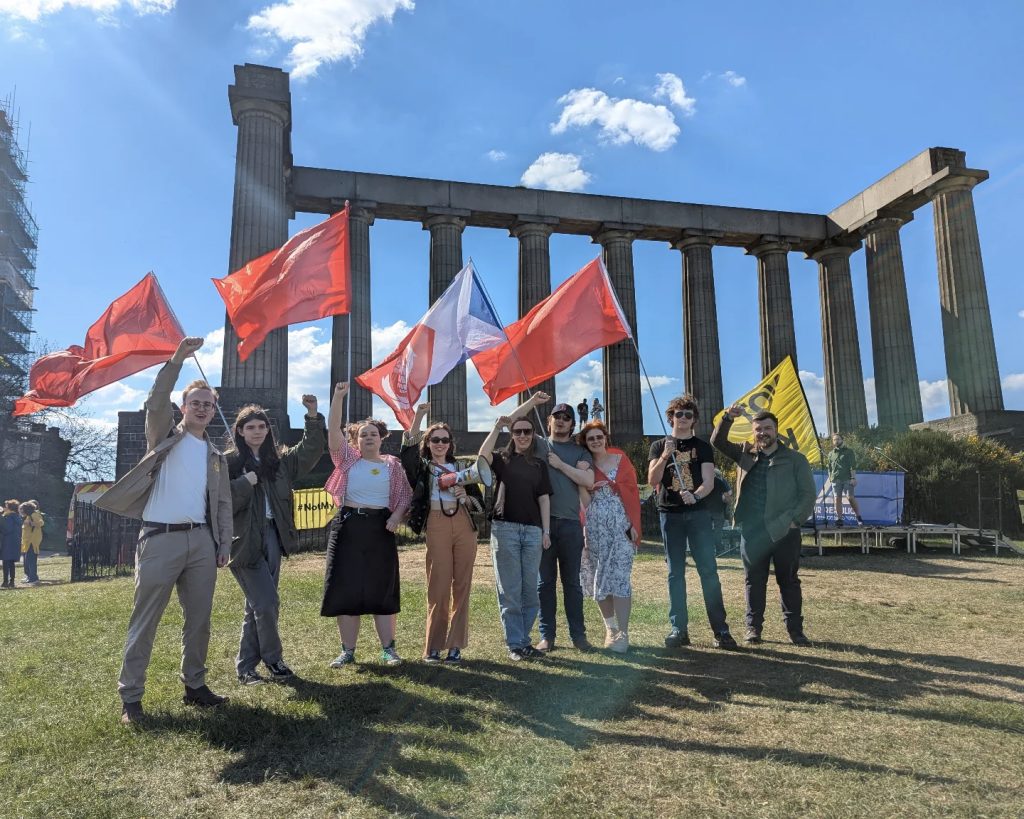
We are left with little other conclusion than we are in desperate need of a new left-wing political party in Scotland, one which is capable of both delivering independence and meeting the challenge of building a new nation afterwards. We in the Scottish Socialist Youth therefore resolved to advocate for and support the creation of a new party at our national conference in January, and to work with any other similarly-minded groups who share our vision for a socialist Scottish republic.
The positive case for a new party
One key issue raised in last month’s Heckle article that, among those who are already advocating for a new party, there is not much of a positive case being made. For the sake of brevity, I am going to take as a given that the left needs to make a positive case in defence of immigration and trans rights if we are to repel the threat of the far-right in relation to these issues. This case is well argued in that article.
It is fair to say, though, that the threat posed by Reform and the failures of the UK Labour government have been well recognised, but the case for an entirely new vehicle has not been well articulated. The underlying point here is that there is not currently a party arguing for genuinely transformative socialist policy platform, or a party willing to take a bolder, more radical position on independence, even in the face of the brutal reality that we are unlikely to be gifted another referendum by the British government – particularly not by one that is increasingly likely to be led by Nigel Farage.
There is no party utilising the potential that a radical vision for independence has to politically engage working-class communities, as we saw in the 2014 referendum campaign. Independence needs to be brought back to the fore as something radically disruptive. Seizing this vast gap in Scottish politics is perhaps the best chance we have of taking on the far-right and winning – by seriously engaging with working class communities, and developing a socialist programme for independence that offers genuine material change.
This brings us to perhaps the most important aspect of any new party – it must be a social movement, built from the grassroots upwards, as well as an electoral vehicle. What this means in practice is that any new party must be well-rooted in the communities in which it operates – organising and building mutual aid networks within these communities, as well as seeking to actively politicise community members through this organising. In the bluntest terms, the party cannot simply show up during the campaign begging for votes and disappear again afterward.
This is how the left can counter the shallow electoralism which has plagued the numerous pop-up parties over the past few years (RISE being maybe the most egregious example). It’s something that the Scottish Socialist Party initially did relatively successfully, in part because it had developed from Scottish Militant Labour, which was a major player in the anti-poll tax campaign of the late ’80s and early ’90s. This helped to firmly embed it within working-class communities across the country at the most local level, and meant that when the SSP was eventually formed, it had a base with whom it already had a strong connection, in large part because it had tangibly benefitted these communities by helping to scrap the poll tax.
We in the SSY are seeking to reflect this sort of work in our own campaigning – in Glasgow, for instance, we have been running a free, non-means tested community meal in the city for over a year, and in the last few months have been running a free food stall in Maryhill, serving hot meals to anyone who wants them while simultaneously collecting donations for St Gregory’s Food Bank, which serves the area around the Wyndford housing scheme.
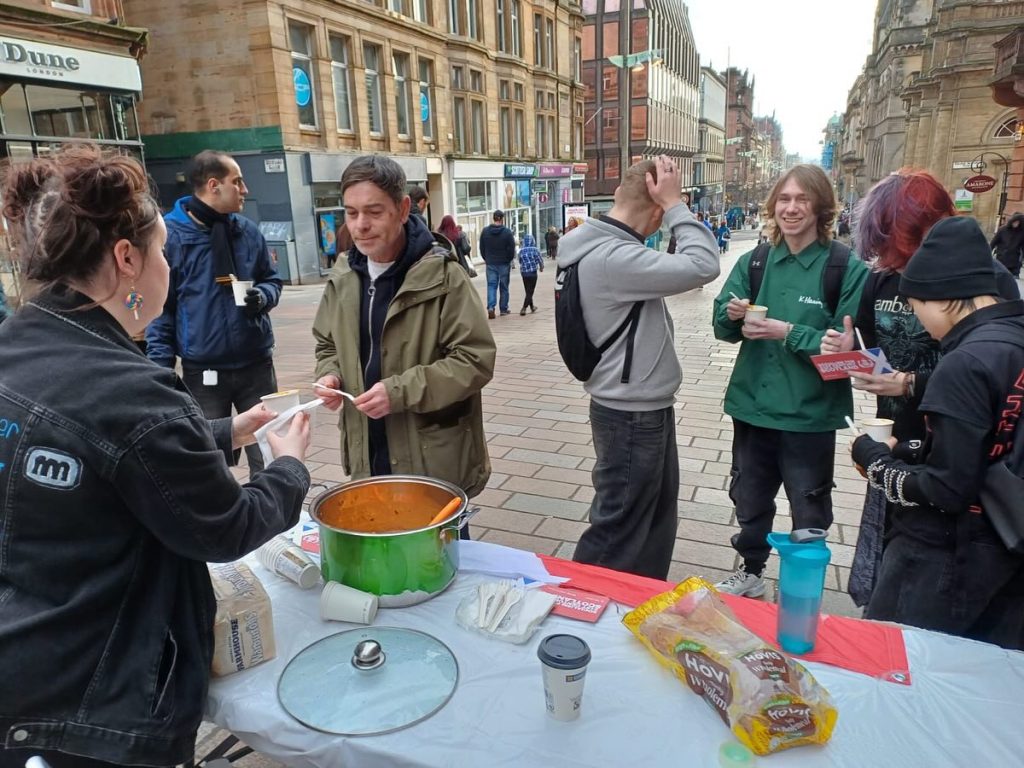
Our newest branch in Edinburgh have also begun similar mutual aid work in collecting for food banks, while our comrades in Forth Valley are also starting a new campaign around food poverty. By building connections with local groups and being an active presence in our communities, we are both developing our presence and spreading our political message while providing a tangible benefit to the communities we live in. Socialists are already delivering for communities where governments both local and national have failed – this is the type of work a new left party should be doing, to ensure it is a vital part of the communities it operates in, rather than showing up scrambling for votes at election time and then disappearing entirely. It is the sort of community-building work that all of our major parties have failed to do.
This also gives us an effective means to challenge Reform – a party funded by billionaires to benefit billionaires will not be able to portray itself as an authentic voice of the community if we already are that voice. The need to take the time to build ourselves into communities is exactly why, in my view, any new left-wing vehicle should not rush into contesting next year’s Holyrood elections. The reality is that we simply do not have the necessary time to build the kind of presence we need to be successful, and we would very quickly risk turning into the same kind of pop-up party that has failed in the past – but that does not mean that the formation of a new party is not worthwhile.
The fight against the far-right is not limited to one election campaign, and the Scottish left shouldn’t consign itself to the path of least resistance. As daunting as the challenge is, we need to actively build new party structures in working-class communities if we are to have any chance of halting Reform UK on their path to power. With local elections due just a year after the Holyrood election, a new party should be seeking to build itself as an integral part of working-class communities across the country now more than ever. None of the major pro-independence parties are up to the challenge, either of delivering independence itself or of enacting a radical programme that will change people’s lives for the better, so we’re taking matters into our own hands.
- Heckle has called for and is delighted to publish contributions from a range of socialist writers on the challenges facing the Scottish left in the run-up to the Holyrood elections next year. If you want to share your own views, get in touch with our editorial board.

Contributor
Owen Maitland is national chairperson of the Scottish Socialist Youth, and was a founding member of its Glasgow branch. He was formerly involved with This Is Rigged, and has been an active campaigner against food poverty in Glasgow since 2023.